
Lightly-marked juvenile Northern Goshawk
2 April 2015
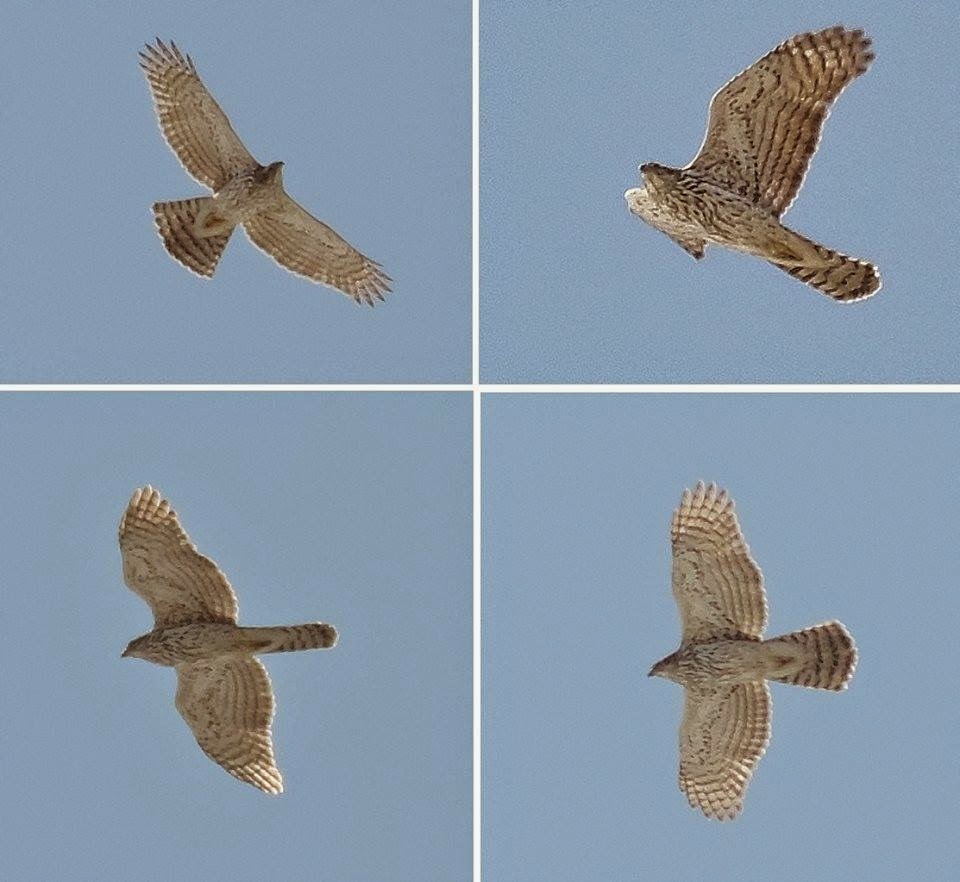
On 2 April 2015, I was treated to close views of a very fascinating juvenile (first year) Northern Goshawk at Greenland Road Hawkwatch site in Dunrobin, Ontario. Note that the bird above showcases a plumage rather similar to a juvenile Cooper’s Hawk (light, thin streaking, heaviest at the breast, tapering toward the lower belly); note, also, the undertail is completely unmarked. The superficial resemblance of Cooper’s stops rather abruptly upon examination of the GISS (General Impression of Size and Shape) of the bird above. Note its massive build; very broad chest (dwarfing the head), long and broad tail, significant bulge to the secondaries, and the strongly tapered hands. A Cooper’s Hawk, in general, is a lean, lengthy, and athletic-appearing bird. The wings lack the dramatic bulge along the trailing edge of the secondaries (as seen with the bird above), the chest is thinner, and the “hands” are not as strongly tapered as in goshawk (esp. male goshawks).
_______________________________________________________________________
Vesper Sparrows along Viewbank Road
26 April 2015
On 20 April, I observed 6 Vesper Sparrows along a 1.2 km long stretch of Viewbank Rd. (just outside of Manotick). I checked the location again late this aft, at 6:15 PM (Vesper’s have a tendency to sing throughout the late aft and into the early eve; hence the name!). I was pleased to once again come across Vesper’s along this road! I observed 2 battling over some turf out in a field and also a singing individual (photo). In spring, males often sing from conspicuous perches, such as fence posts and the tops of shrubs.
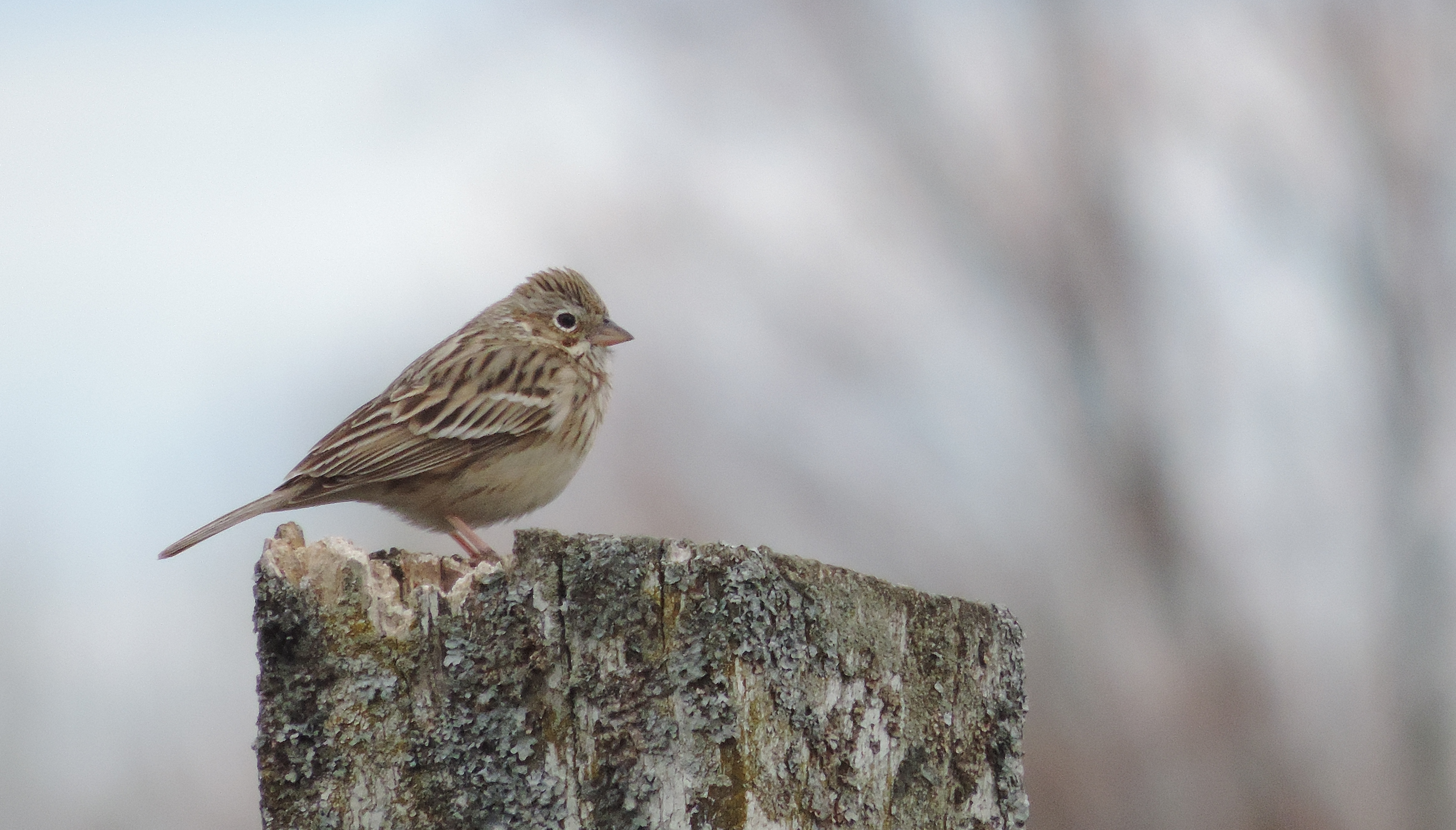 Photo: ID of perched birds: Vesper Sparrows are relatively featureless, streaky sparrows. The characteristic white outer tail feathers and rufous lesser coverts (shoulder area) are rarely visible on a perched bird (Beadle & Rising, 2002). The thin, bold white eye ring and creamy submoustachial stripe (pale “bar” extending horizontally out from the base of the lower mandible), pinkish bill (slightly dusky upper mandible, pinkish lower) and dark-bordered ear coverts offer an entirely unique and subtly beautiful expression.
_______________________________________________________________________
Marble Lake Conservation Area – Gananoque
1 May 2015
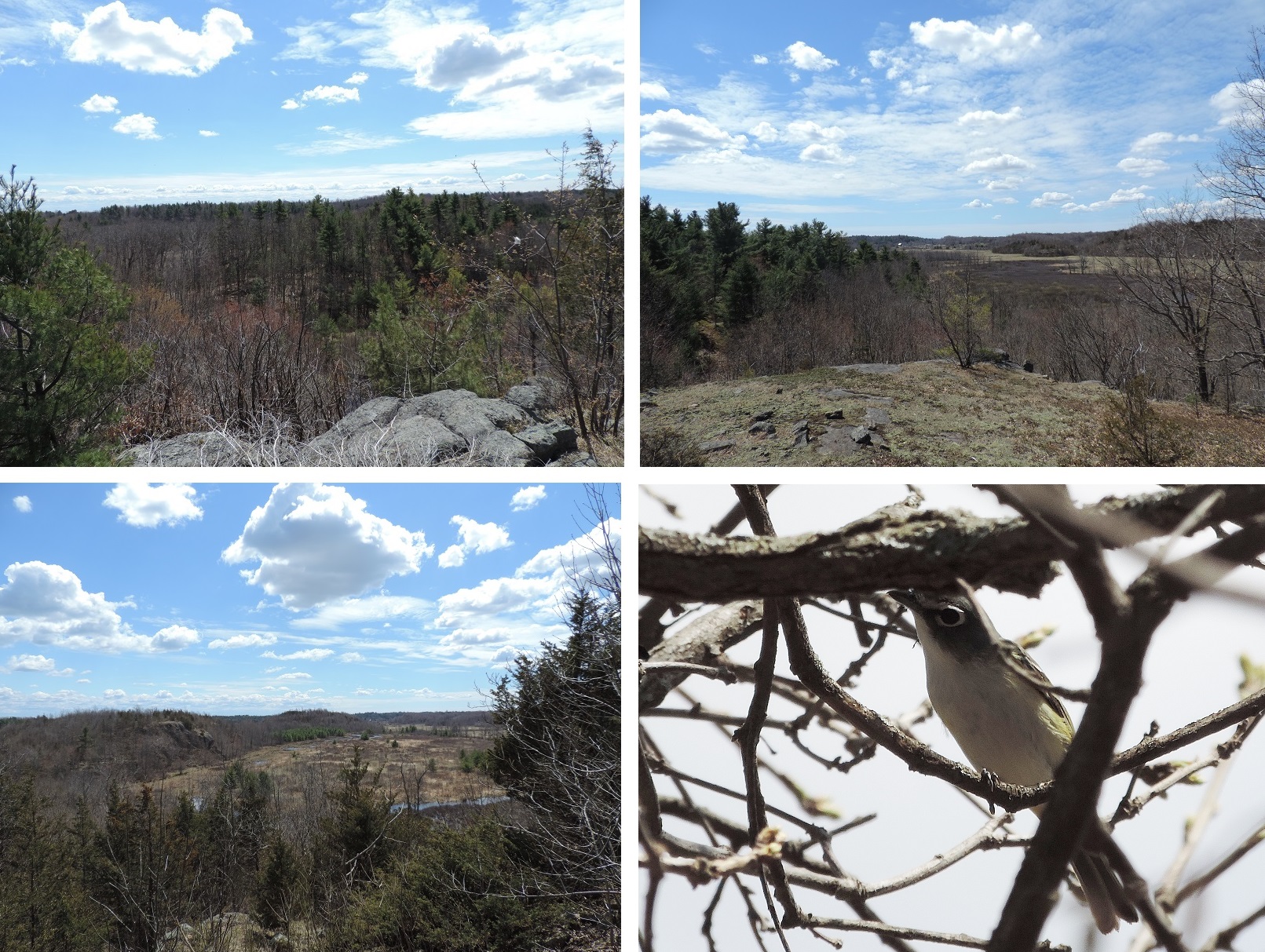 Photo: A beautiful day for a hike! Marble Lake C.A. offers many excellent birding opportunities throughout its many kilometers of backcountry-style trails. A classic southern Frontenac Axis site consisting of mature white oak, red oak, and blue beech as well as many stands of shagbark hickory throughout the rugged landscape. Birds like Yellow-throated Vireo, Yellow-billed Cuckoo, Blue-gray Gnatcatcher, Blue-winged and Golden-winged Warbler breed here. Looking forward to visiting this site again in three weeks time!
________________________________________________________________________
Yellow-throated Vireo – Crow Lake
4 May 2015
Flycatcher, and Rose-breasted Grosbeak.
Golden-winged Warblers (3) along Ennis Road
11 May 2015
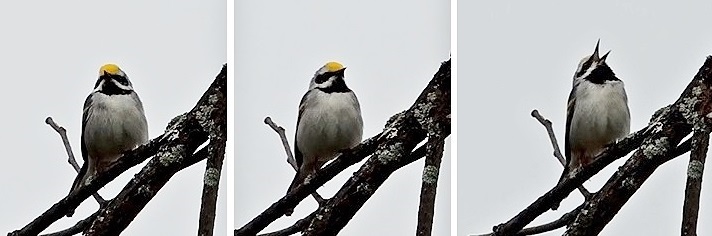
Photo: Stylized photo of one of the singing male Golden-winged Warblers.
Today (11 May 2015) I birded some quiet back roads near Bennett Lake in Balderson (Lanark County, 20 km NW of Perth), walking 13-15 km in total, starting @ Anderson Side Rd. and finishing at the S end of Ennis Rd. While on Ennis, I observed 3 Golden-winged Warblers within a 50 m radius, roughly 2 km from the S end. In general, quite a density of birds, with many in song, including: Rose-breasted Grosbeak (13), Veery (9), Wood Thrush (2), Scarlet Tanager (9), Ovenbird (15), Black-throated Green Warbler (8), and Great Crested Flycatcher (6).
Directions: From Hwy. 7, take Harper Rd. NW to Keays Rd., then head W (left) on Keays, then N (right) on Old Morris. Take Old Morris N to Concession 9, then head E (right). Anderson Side Rd. is your next left.
___________________________________________________________________________
“Looking” at Similar Songs
25 May 2015
Learning birdsong can be quite a challenge! For some, mnemonics work quite well, i.e. the familiar “sweet-sweet-shredded wheat!” of a Yellow Warbler singing from a swampy roadside thicket. For others (myself included) visualization is perhaps the key element to learning each song and getting ’em glued into the memory bank. Personally speaking, I find studying the audio spectrograph of the song I’m looking to learn more about extremely useful and a great learning tool. There are some excellent websites and apps out there but I can’t seem to find one that tops the website, Xeno Canto. Regarding reading the spectrograph: pitch is shown vertically (y-axis) and time is shown horizontally (x-axis). Volume is shown by the intensity of black (pitch black denotes high volume; translucent black denotes low volume) and tonal quality is shown by the shape and size of the notes; i.e. a Baltimore Oriole’s flute-like notes would appear thin and crisp, and a Yellow-throated Vireo’s husky notes would appear thick and blurry.
 Photo: A comparative audio spectrograph of similar-sounding songs. From top to bottom: Scarlet Tanager, American Robin, and Rose-breasted Grosbeak. Note: the typically loud, husky, fast-sequenced song of a Scarlet Tanager; the relatively quiet, flute-like, slower-paced song of an American Robin; and the strong, fast-paced, thin, and well-defined notes of a Rose-breasted Grosbeak.
Reference Numbers: Scarlet Tanager (XC20432), American Robin (XC131877), Rose-breasted Grosbeak (XC134869).
Link to Xeno Canto: http://www.xeno-canto.org/
_________________________________________________________________________
ID Note: Pine Warbler (Setophaga pinus)
4 June 2015
Today, 4 June 2015, along the N shore of Crow Lake in Central Frontenac, I observed a female Pine Warbler foraging along a rocky slope, collecting caterpillars to feed to its young. Female Pine Warblers are a challenge to ID as they’re often quite drab and grayish overall, like this one. Some ID pointers, from bill-to-tail:

Photo: Pine Warbler (f). Note: large bill; faint, thin, dark eye line ‘cutting’ through two thin white eye arcs; pale supraloral (area just above the area between base of bill and the eye); pale neck contrasting w/ slightly darker cheeks; pale yellowish below (varying intensity), light olive-gray and generally unstreaked above; two whitish wing bars; short primary projection; long tail.
Overall GISS: Husky, large-billed, long-tailed warbler.
________________________________________________________________________
ID Note: Cerulean Warbler (Setophaga cerulea)
2 July 2015

Photo: Cerulean Warbler (female). Today (2 July 2015) @ Frontenac Provincial Park just N of Sydenham, I had the pleasure of observing a female Cerulean Warbler foraging uncharacteristically low to the ground…..def. a far cry from way up in the the canopy of a mature hardwood! Cerulean Warblers are quite portly in GISS; this overall shape is derived from the combination of a short and stout bill, husky neck, pot belly, and very short tail. The long and pointed wings, often drooped in orientation, polish off its entirely unique and charming build. Females show a dark eye line and conspicuous eyebrow (supercilium) and variable underpart coloration ranging from drab whitish-pale yellow, to yellowish-green.
_________________________________________________________________________